10 Bathroom Tiling Trends in Queensland (2026)
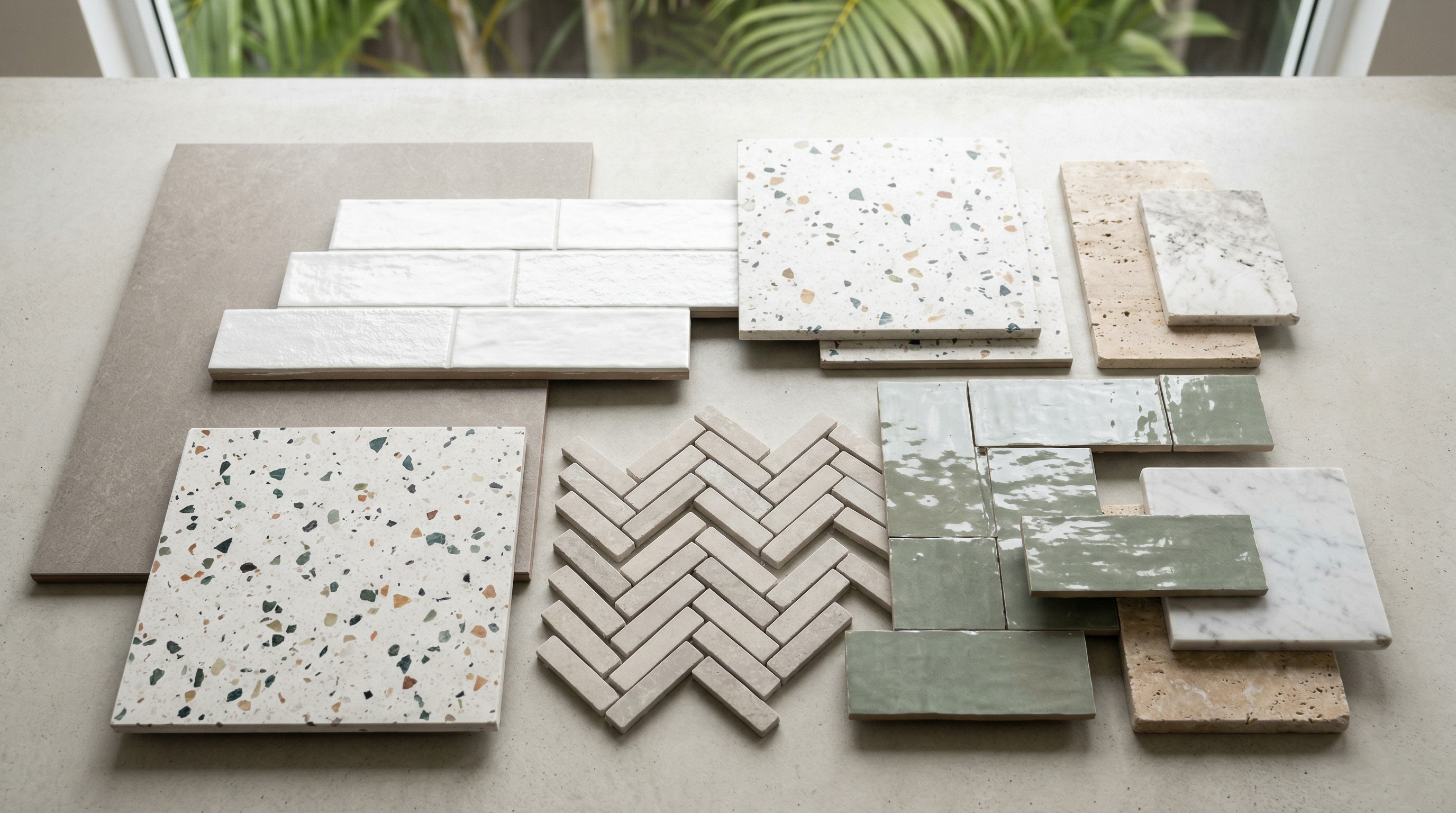
What Queensland Homeowners Are Choosing for Bathroom Tiles in 2026
Tile selection shapes the entire look and feel of a renovated bathroom. It is also one of the most permanent choices you make during a renovation, since most tile installations last 15 to 25 years before needing replacement. Getting the tile choice right means balancing aesthetics with practical performance, and in Queensland, practical performance includes handling humidity, resisting mould, withstanding temperature swings, and meeting slip resistance requirements for wet areas. These are the ten bathroom tiling trends that Queensland homeowners and designers are favouring in 2026, with notes on why each trend works in Queensland conditions and which spaces suit it best.
1. Large-Format Porcelain (600×1200mm and Above)
Large-format tiles have moved from a luxury choice to the default for mid-range and premium Queensland bathroom renovations. Tiles sized 600×1200mm or even 800×1600mm dramatically reduce grout lines, creating clean, uninterrupted surfaces that make bathrooms feel more spacious.
The practical benefits for Queensland are significant. Fewer grout joints mean fewer places for mould to establish, which matters in a climate where bathroom humidity routinely sits above 70%. Large tiles also reduce cleaning time because smooth porcelain surfaces are simpler to wipe down than grout channels.
Installation requires a skilled tiler with experience handling large, heavy tiles. Substrate preparation must be precise because any unevenness in the wall or floor becomes visible across a large tile surface. Expect to pay a small premium for installation labour compared to standard 300×600mm tiles. The supply cost for quality large-format porcelain ranges from $50 to $120 per square metre depending on the finish.
Best for: Main bathrooms, ensuites, and any space where you want a contemporary, minimal look with reduced maintenance.
2. Matte and Honed Finishes
Gloss tiles dominated Queensland bathrooms for decades, but the shift toward matte and honed (softly polished) finishes has been steady. Matte tiles hide water spots, soap residue, and fingerprints far more effectively than gloss surfaces, reducing the visible impact of Queensland’s hard water, which affects areas like Toowoomba, the Darling Downs, and parts of inland Queensland where mineral content in the water supply leaves calcium deposits on shiny surfaces.
Matte floor tiles also offer better slip resistance than their polished counterparts. A matte porcelain tile can achieve R10 or R11 slip resistance ratings without needing a textured surface that traps dirt. For shower floors where barefoot grip is critical, matte finishes are the practical and increasingly the aesthetic preference.
Best for: Floors throughout the bathroom, shower walls, and any surface where low-maintenance appearance matters.
3. Natural Stone Look Porcelain
Natural stone bathrooms (marble, travertine, limestone) convey luxury, but genuine stone requires sealing, ongoing maintenance, and careful product selection to avoid staining and etching. Porcelain tiles that replicate natural stone patterns have reached a level of visual fidelity that makes them nearly indistinguishable from real stone once installed.
Queensland homeowners increasingly choose stone-look porcelain because it delivers the aesthetic of marble or travertine without the maintenance vulnerability. Porcelain is non-porous, meaning it does not absorb water, resist staining without sealing, and tolerates Queensland’s cleaning products without etching. Calacatta marble-look, warm grey travertine-look, and terrazzo-inspired patterns are the most requested styles across Brisbane and Gold Coast tile showrooms in 2026.
For a cohesive look, consider using the same stone-look porcelain on both floor and walls. Matching floor and wall tiles from the same range ensures colour consistency and creates a seamless, high-end appearance. Discuss layout and vein-matching with your tiler to avoid repeating patterns that break the natural stone illusion.
Best for: Luxury bathroom renovations and ensuites where the homeowner wants a premium look with practical durability.
4. Vertical Stack Bond Layout
The way tiles are laid affects the perception of space as much as the tile itself. Vertical stack bond, where rectangular tiles are laid in straight vertical columns rather than the traditional offset brick pattern, has become a defining feature of contemporary Queensland bathrooms.
Vertical lines draw the eye upward, emphasising ceiling height and making rooms feel taller. This effect is particularly valuable in small bathroom renovations and older Queenslander homes where floor area is limited but ceiling height is generous. The clean vertical lines also pair well with large-format rectangular tiles (300×600mm or 300×900mm), creating a grid-like pattern that reads as modern and intentional.
Stack bond is purely an installation pattern, so it costs the same as brick bond in labour. The only consideration is that stack bond is less forgiving of tiles with slight size variations (common in handmade or artisanal tiles), because misalignment is more visible when grout lines run in continuous straight columns. Use rectified (precision-cut) tiles for the cleanest result.
Best for: Feature walls, shower recesses, and powder rooms where vertical emphasis enhances the sense of space.
5. Textured and Three-Dimensional Tiles
Flat, smooth wall tiles are giving way to tiles with subtle surface texture, ribbed profiles, fluted patterns, and three-dimensional relief. These tiles add visual depth and tactile interest to bathroom walls without relying on colour contrast or busy patterns.
Fluted tiles (with evenly spaced vertical ridges) are the most popular textured format in Queensland in 2026. They catch and reflect light at different angles throughout the day, creating movement on what would otherwise be a static surface. White or neutral-coloured fluted tiles on a feature wall behind the vanity or in the shower recess add sophistication without overwhelming a small space.
The practical consideration with textured tiles is cleaning. Ridges and relief surfaces collect soap scum and moisture more readily than flat tiles. In Queensland’s humid bathrooms, regular cleaning is necessary to prevent grime buildup in the crevices. Use textured tiles on walls rather than floors, where flat surfaces are easier to maintain and safer for slip resistance.
Best for: Feature walls, vanity splashbacks, and shower accent areas. Avoid on floors or large horizontal surfaces.
6. Warm Neutral Colour Palettes
The all-white bathroom is losing ground to warm neutrals: soft beige, warm grey, greige (grey-beige), sandstone tones, and muted terracotta. These colours create a warmer, more inviting atmosphere while maintaining the light, open feel that works in Queensland homes.
Warm tones complement Queensland’s natural light quality, which tends to be bright and slightly warm due to the subtropical latitude. A cool grey tile that looks elegant under showroom lighting can appear stark and clinical under direct Queensland sun streaming through a bathroom window. Warm neutrals absorb and soften that light, producing a more comfortable visual environment.
Pairing warm wall tiles with a slightly darker warm-toned floor tile creates subtle depth without the stark contrast that can make a small bathroom feel choppy. The current preference is for minimal colour variation between floor and walls, unified by the same warm undertone.
Best for: Entire bathrooms, particularly those with natural light. Works across all renovation budgets.
7. Zellige and Handmade-Look Tiles
Zellige tiles, originally handmade Moroccan glazed terracotta, have surged in popularity. True zellige tiles feature slight variations in colour, surface texture, and thickness that create a characterful, handcrafted appearance. Each tile is unique, producing a shimmering, undulating wall surface that looks entirely different from machine-made uniformity.
Authentic zellige tiles are expensive ($100 to $200+ per square metre) and require a tiler experienced with irregular-thickness installations. However, several Australian and European manufacturers now produce machine-made tiles that capture the zellige aesthetic, with controlled colour variation and subtle surface undulation, at $40 to $80 per square metre.
These tiles work best in small doses. A full bathroom of zellige can feel busy. One feature wall, a shower recess, or a vanity splashback is enough to introduce the texture and character without overwhelming the space. Pair with simple large-format tiles on remaining surfaces for balance.
Best for: Powder room renovations, feature walls, vanity splashbacks, and shower niches.
8. Micro-Cement and Seamless Surface Finishes
Micro-cement (also called micro-topping) is a thin cementitious coating applied over existing surfaces to create a seamless, grout-free finish. While not technically a tile, it competes directly with tiling as a wall and floor finish in contemporary bathroom design.
The appeal is obvious: no grout lines at all. The result is a continuous, velvety surface that can wrap from floor to walls to ceiling without a single joint. Micro-cement is waterproof when properly sealed and can be applied directly over existing tiles (avoiding demolition costs) or onto new plasterboard and concrete substrates.
In Queensland, micro-cement requires a protective sealer to resist the higher moisture exposure in subtropical bathrooms. The sealer needs reapplication every 3 to 5 years to maintain its waterproof performance. It is also more susceptible to scratching and staining than porcelain tile, so it suits walls and floors that won’t be subjected to heavy abrasion.
Application is a specialist skill. Not every bathroom resurfacing contractor offers micro-cement, and quality depends heavily on the applicator’s experience. Ask to see completed projects before committing.
Best for: Contemporary minimal designs, powder rooms, and feature walls where a seamless, organic aesthetic is the priority.
9. Penny Round and Mosaic Tiles for Shower Floors
While large-format tiles dominate walls and main floors, small-format mosaic tiles and penny rounds are increasingly specified for shower floors. The reason is practical rather than purely aesthetic: smaller tiles with more grout joints conform better to the fall (gradient) required to drain water toward the shower waste.
A shower floor typically needs a 1:60 to 1:80 fall to the drain point. Large tiles laid over this gradient can create visible lippage (uneven edges) where tiles meet. Mosaic tiles (25×25mm to 50×50mm) and penny rounds (diameter 19mm to 28mm) flex around the gradient smoothly, producing a consistently flat surface that drains properly without tripping hazards.
For slip resistance, unglazed porcelain mosaics with a matte finish achieve R11 or R12 ratings, making them the safest option for wet shower floors. In Queensland, where bare feet and wet surfaces are a daily combination, this safety factor is worth prioritising.
Mosaics come on mesh-backed sheets for faster installation. Budget $60 to $120 per square metre installed. Popular 2026 choices include matte white penny rounds, grey hexagonal mosaics, and natural stone pebble mosaics.
Best for: Shower floors exclusively. Combine with large-format wall tiles for contrast.
10. Colour-Matched Grout
Visible grout lines have traditionally been a maintenance headache and a visual distraction. Colour-matched grout, where the grout colour closely matches the tile colour, minimises the appearance of joints and creates a more unified surface.
White tiles with white grout, grey tiles with grey grout, warm neutral tiles with a matching neutral grout: these combinations reduce visual noise and let the tile surface itself be the focus. The effect is particularly strong with large-format tiles where the remaining grout lines are already thin (1.5 to 2mm joints).
For practical performance in Queensland, specify epoxy grout regardless of colour. Epoxy grout resists mould, staining, and moisture far more effectively than traditional cement-based grout. It costs more ($8 to $12 per kilogram versus $3 to $5 for cement grout) but eliminates the need for regular re-grouting and reduces mould growth in humid conditions. Your tiler can advise on the closest colour match to your chosen tile.
Best for: Any tile installation where a clean, seamless appearance is desired. Especially effective with large-format and light-coloured tiles.
Choosing Tiles That Work in Queensland Conditions
Beyond aesthetics, every tile choice in a Queensland bathroom should account for:
- Slip resistance: Australian Standard AS 4586 classifies slip resistance from R9 (lowest) to R13 (highest). Bathroom floors need a minimum R10 rating. Shower floors should be R11 or higher. Always check the slip rating before purchasing, especially for polished or glazed tiles.
- Porosity: Tiles are rated by water absorption. Porcelain (less than 0.5% absorption) is ideal for wet areas. Ceramic (3 to 6% absorption) is acceptable for walls but less suitable for shower floors. Natural stone varies widely and usually requires sealing.
- Thermal expansion: Queensland’s temperature range (from cool winter mornings to hot summer afternoons) causes tiles and substrates to expand and contract. Flexible tile adhesive and appropriately spaced movement joints prevent cracking from thermal stress.
Frequently Asked Questions
Q: What is the best tile size for a small Queensland bathroom?
Large-format tiles (600×600mm or 600×300mm) work best in small bathrooms because fewer grout lines create a cleaner, more spacious appearance. Using the same tile on floors and walls further enhances the sense of continuity. For shower floors, switch to small-format mosaics (25 to 50mm) to accommodate the drainage gradient. Avoid mixing too many tile sizes or colours in a small space, as visual complexity makes tight rooms feel busier and smaller.
Q: How do I choose between porcelain and ceramic tiles for a Queensland bathroom?
Porcelain is the stronger choice for Queensland bathrooms. Its water absorption rate is below 0.5%, compared to 3 to 6% for ceramic, making it more resistant to moisture penetration in a humid climate. Porcelain is also harder and more durable, resisting scratches and chips better than ceramic. Ceramic tiles cost less ($20 to $40 per square metre versus $40 to $120 for porcelain) and work well on walls where moisture exposure is lower, but porcelain is recommended for floors and shower areas.
Q: Are natural stone tiles a good choice for Queensland bathrooms?
Natural stone tiles (marble, travertine, limestone) are beautiful but require more maintenance than porcelain in Queensland’s humid conditions. Stone is porous and must be sealed before installation and re-sealed every 1 to 2 years to prevent water absorption, staining, and mould growth in the stone pores. Acidic cleaning products damage stone surfaces. If you want the stone aesthetic with lower maintenance, stone-look porcelain tiles offer a practical alternative. If you choose genuine stone, budget for ongoing sealing and use pH-neutral cleaning products only.
Q: What slip resistance rating do I need for bathroom floor tiles?
Australian Standard AS 4586 applies. Bathroom floors require a minimum R10 slip resistance rating. Shower floors, where water is constantly present and users are barefoot, should be R11 or higher. Matte and textured finishes generally achieve higher slip ratings than polished or gloss tiles. Always request the slip resistance test certificate from the tile supplier before purchasing, particularly for imported tiles where Australian testing may not have been performed.
Find the Right Tiling Specialist for Your Renovation
The tiles you choose set the visual tone of your bathroom for the next two decades. Take the time to visit showrooms, request samples to view in your actual bathroom lighting, and discuss layout options with a qualified tiler who understands Queensland conditions. Browse our directory to connect with experienced bathroom tiling specialists and bathroom design professionals across Queensland who can help you select and install tiles that perform as well as they look.
Ready to Start Your Renovation?
Browse our directory to find trusted bathroom renovation specialists across Queensland.