Waterproofing Requirements for QLD Bathrooms (AS 3740)
Why Waterproofing Is the Most Critical Part of Any Queensland Bathroom Renovation
Waterproofing failures are the most expensive and destructive problems that can occur in a bathroom. A failed membrane allows water to seep through tiles and into the building structure underneath, rotting timber framing, corroding steel, promoting mould growth inside wall cavities, and eventually damaging adjacent rooms. In Queensland’s subtropical and tropical climate, where humidity regularly exceeds 70% and heavy rainfall is a seasonal constant, the consequences of poor waterproofing escalate faster than in drier climates. Timber frames stay damp longer, mould establishes more aggressively, and structural damage compounds quickly. This guide explains Queensland’s waterproofing requirements under Australian Standard AS 3740-2021, what every homeowner should know before and during a renovation, and why cutting corners on waterproofing is never worth the short-term savings.
What Is AS 3740 and Why Does It Matter?
AS 3740-2021 is the Australian Standard for waterproofing of domestic wet areas. It sets out the minimum requirements for where and how waterproofing membranes must be applied in bathrooms, laundries, and other wet areas. The National Construction Code (NCC) references AS 3740 as the deemed-to-satisfy standard for waterproofing compliance across Australia, and Queensland building legislation enforces it through the QBCC regulatory framework.
In practical terms, AS 3740 tells your renovator exactly which surfaces must be waterproofed, to what height, using which types of membranes, and how those membranes must be installed and tested. It is not optional. Every bathroom renovation in Queensland that involves removing existing waterproofing (which happens any time you strip tiles from a wet area) must re-waterproof to the current AS 3740 standard, even if the original bathroom was built to an older code.
Which Areas Must Be Waterproofed?
AS 3740-2021 divides bathroom surfaces into mandatory waterproofing zones. Here is what the standard requires for a typical residential bathroom:
Shower floor and walls:
- The entire shower floor must be waterproofed, including the area under the shower screen or enclosure.
- Shower walls must be waterproofed to a minimum height of 1,800mm above the finished floor level. If the showerhead is mounted higher than 1,800mm, the membrane must extend at least 150mm above the showerhead height.
- The wall area directly above a hob or shower screen (if present) must be waterproofed to the full 1,800mm height on both sides.
Bathroom floor:
- The entire bathroom floor must be waterproofed, including under the toilet, vanity, and any freestanding bath.
- The membrane must extend up each wall (the “turn-up”) by a minimum of 100mm above the finished floor level in areas outside the shower.
Bath surround:
- If a bath is positioned against a wall, the wall behind and beside the bath must be waterproofed from the rim of the bath upward to a minimum of 150mm above the bath overflow level.
Areas around fixtures:
- All floor waste penetrations, pipe penetrations, and junctions between the floor and walls must be sealed with compatible waterproofing products and reinforced with bond-breaker tape or fabric membrane strips.
Bathroom door threshold:
- The waterproofing must extend across the full width of the doorway. A hob (step-up) or recessed channel is typically used to contain water at the bathroom entry.
Membrane Types Used in Queensland
Several waterproofing membrane systems are used in Queensland bathrooms. Each has advantages and limitations:
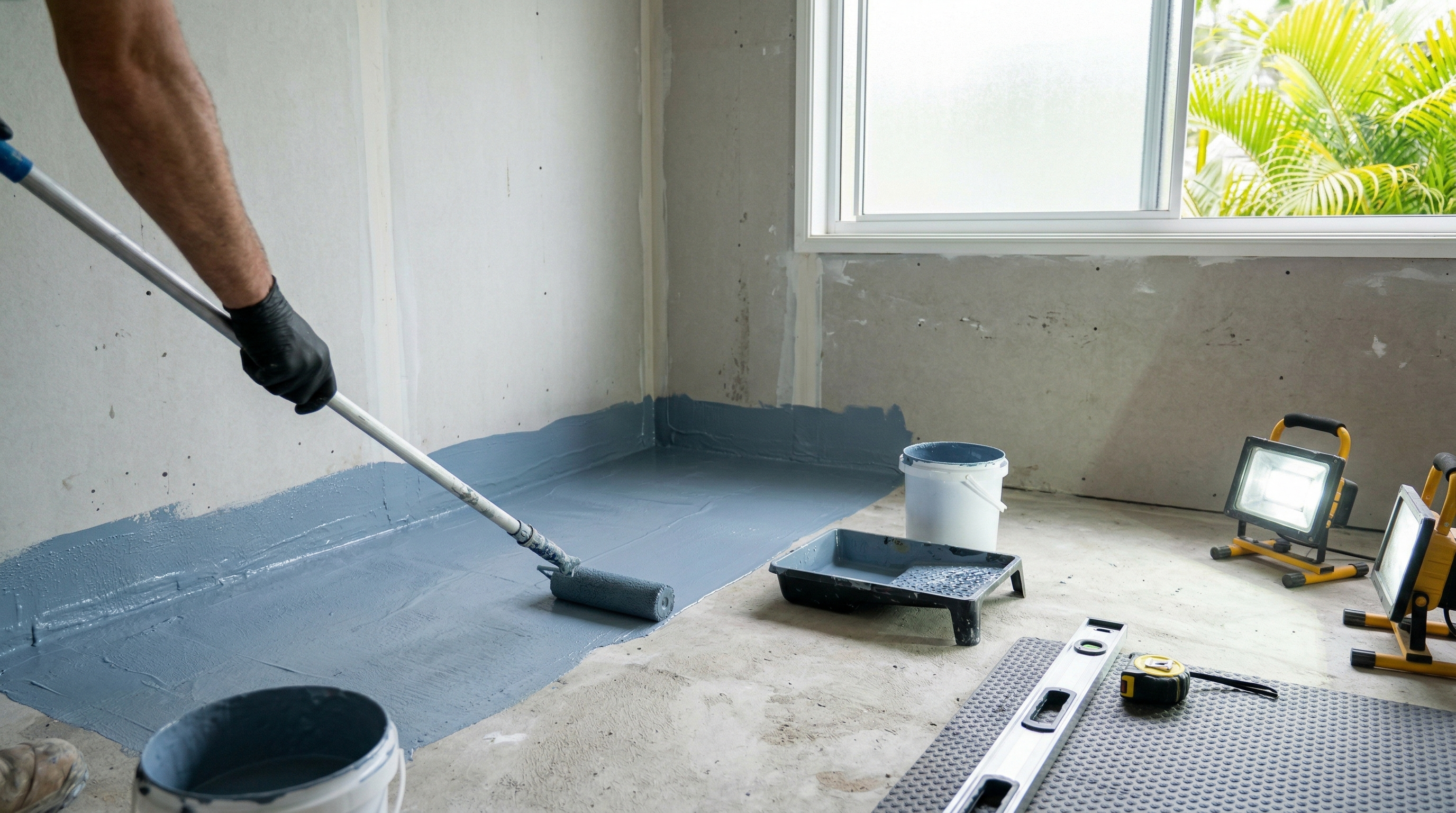
Liquid-applied membranes: The most common system for bathroom renovations. A liquid polymer (typically acrylic or polyurethane based) is rolled or brushed onto the substrate in two or more coats, forming a seamless, flexible membrane once cured. Liquid membranes conform to irregular surfaces, corners, and penetrations, making them ideal for renovation work where substrates are rarely perfectly flat. Most Queensland waterproofing contractors use liquid-applied systems.
Sheet membranes: Pre-manufactured polyethylene or bituminous sheets applied with adhesive. Sheet membranes offer consistent thickness and are effective for large, flat surfaces. However, they require careful detailing at corners, penetrations, and junctions, where overlaps must be sealed to prevent water entry.
Cementitious membranes: A cement-based coating that bonds directly to concrete substrates. Less flexible than liquid polymers, which makes them less suitable for timber-framed Queensland homes where slight structural movement can crack a rigid membrane.
Regardless of the membrane type, AS 3740 requires a minimum dry film thickness (DFT) that varies by product specification. Your waterproofer should verify thickness using a wet film gauge during application and allow each coat to fully cure before applying the next. In Queensland’s humid conditions, curing times can be longer than the manufacturer’s standard recommendations, particularly during the wet season (November to April) when ambient humidity slows drying.
The Waterproofing Compliance Certificate
After waterproofing is complete and before tiling begins, your waterproofing contractor should issue a Form 43 Compliance Certificate (or equivalent documentation depending on the certifier). This certificate confirms that the waterproofing has been inspected and meets AS 3740 requirements.
Why this certificate matters:
- It is your proof that the waterproofing was installed correctly if a defect appears later.
- It is required by the QBCC if a building certifier inspects the work.
- Without it, you have no documented evidence to support a warranty claim or QBCC complaint.
- If you sell the property, a prospective buyer’s building inspector may ask for waterproofing documentation.
Never let a renovator proceed to tiling without this certificate in hand. Once tiles are laid over the membrane, the waterproofing is permanently concealed and cannot be visually inspected. Any defect becomes exponentially more expensive to fix because the tiles must be removed to access the membrane.
What Happens When Waterproofing Fails
Waterproofing failures often go undetected for months or even years before visible symptoms appear. By the time you notice something, the damage behind the tiles can be extensive.
Early warning signs include:
- Damp or discoloured patches on walls adjacent to the bathroom
- Peeling paint or bubbling wallpaper in rooms sharing a wall with the bathroom
- A musty, mouldy smell that persists despite cleaning
- Tiles that sound hollow when tapped (indicating the adhesive has lost bond due to moisture)
- Visible mould growth in grout lines that returns quickly after cleaning
- Soft or spongy flooring near the bathroom
The cost of repairing a waterproofing failure typically runs $8,000 to $20,000 or more, depending on the extent of damage. This includes stripping all tiles, removing the failed membrane, drying and repairing the substrate (and replacing any rotted timber framing), re-waterproofing, and re-tiling. In severe cases where water has migrated to adjacent rooms, repair costs can reach $30,000 to $50,000 including structural remediation. Compare that to the $1,500 to $3,500 cost of doing waterproofing correctly during a renovation, and the value proposition is clear.
Can You DIY Bathroom Waterproofing in Queensland?
Technically, a homeowner can apply waterproofing in their own home if the total project value stays under $3,300 (the QBCC licensing threshold). However, there are compelling reasons not to:
Compliance risk: If you apply waterproofing yourself and it fails, you have no warranty claim against a contractor and no QBCC dispute resolution path. You bear the full cost of remediation.
Insurance implications: Home insurance policies may deny water damage claims if the waterproofing was not installed by a licensed professional with a compliance certificate.
Technical difficulty: Proper waterproofing requires correct substrate preparation, primer selection for the specific substrate type, multiple membrane coats at the right thickness, precise detailing at corners and penetrations with reinforcement fabric, and adequate curing time between coats. Each step has specific requirements that vary by product. Mistakes are invisible once tiles go on and only reveal themselves through damage months later.
Tile adhesion: Waterproofing membranes must be compatible with the tile adhesive used over them. An incompatible combination can cause tiles to debond, even if both products perform well individually. Licensed waterproofing contractors understand product compatibility and select systems that work together.
For any bathroom renovation of meaningful scope, professional waterproofing with a compliance certificate is the only approach that makes financial and practical sense.
Queensland-Specific Waterproofing Considerations
Several factors make waterproofing particularly important in Queensland compared to southern states:
Humidity and condensation: Queensland bathrooms generate significant condensation, especially in the subtropical south-east and tropical north. Exhaust ventilation is essential to remove moisture from the air, but the waterproofing membrane is your last line of defence against liquid water reaching the structure.
Termite risk: Queensland has the highest termite activity in Australia. Moisture from a waterproofing failure creates exactly the conditions termites seek. A damp wall cavity adjacent to a bathroom is an invitation for termite infestation, which compounds the damage and repair cost significantly.
Queenslander construction: Many older Queensland homes are built on stumps with timber-framed walls and floors. Timber is far less tolerant of moisture than concrete or steel. A waterproofing failure in a Queenslander can cause structural damage faster than in a slab-on-ground brick home.
Cyclone regions: In North Queensland (Cairns, Townsville, Mackay), buildings must meet cyclone-rated construction standards. Waterproofing in these areas needs to withstand higher wind-driven rain pressures, and substrate preparation may differ from standard practices further south.
Frequently Asked Questions
Q: How high does waterproofing need to go on bathroom walls in Queensland?
Shower walls must be waterproofed to a minimum of 1,800mm above the finished floor level under AS 3740-2021. If the showerhead is installed above 1,800mm, the membrane must extend at least 150mm above the showerhead. Non-shower bathroom walls require a minimum 100mm turn-up from the finished floor level. Walls behind and beside a bathtub must be waterproofed to at least 150mm above the bath overflow.
Q: Do I need to waterproof under a freestanding bath?
Yes. AS 3740 requires the entire bathroom floor to be waterproofed, including the area under freestanding baths, toilets, and vanities. The membrane must be continuous across the whole floor with no gaps or breaks, regardless of what fixtures sit on top. This is a common area where shortcuts occur, and it can cause significant damage if the bath develops a slow leak or overflow.
Q: How long does bathroom waterproofing take to cure before tiling?
Curing time depends on the membrane product, number of coats, ambient temperature, and humidity. Most liquid-applied membranes require 24 to 72 hours of curing time between coats and before tiling. In Queensland’s wet season, when humidity is high and temperatures are elevated, curing can take longer. Your waterproofer should test the membrane with a moisture meter before clearing it for tiling. Rushing this step to save a day on the renovation schedule risks adhesion failure between the membrane and tile adhesive.
Q: What should I do if I suspect my existing bathroom has a waterproofing problem?
Look for the warning signs listed above: damp patches on adjacent walls, musty smells, hollow-sounding tiles, or persistent grout mould. If you suspect a leak, contact a bathroom plumbing specialist to rule out pipe leaks first, as these are simpler and cheaper to fix. If pipes are intact, the issue is likely a membrane failure. A building inspector or waterproofing specialist can conduct a flood test (sealing the floor drain and filling the floor with water for 24 hours) to confirm whether the membrane is compromised. Early detection limits the extent of structural damage.
Protect Your Biggest Investment
Waterproofing is not the glamorous part of a bathroom renovation, but it is the part that determines whether your new bathroom lasts 5 years or 25. Insist on AS 3740 compliance, demand the compliance certificate before tiling starts, and hire a licensed waterproofing professional with a track record in Queensland conditions. Browse our directory to find verified waterproofing and bathroom renovation specialists in your area.
Ready to Start Your Renovation?
Browse our directory to find trusted bathroom renovation specialists across Queensland.